
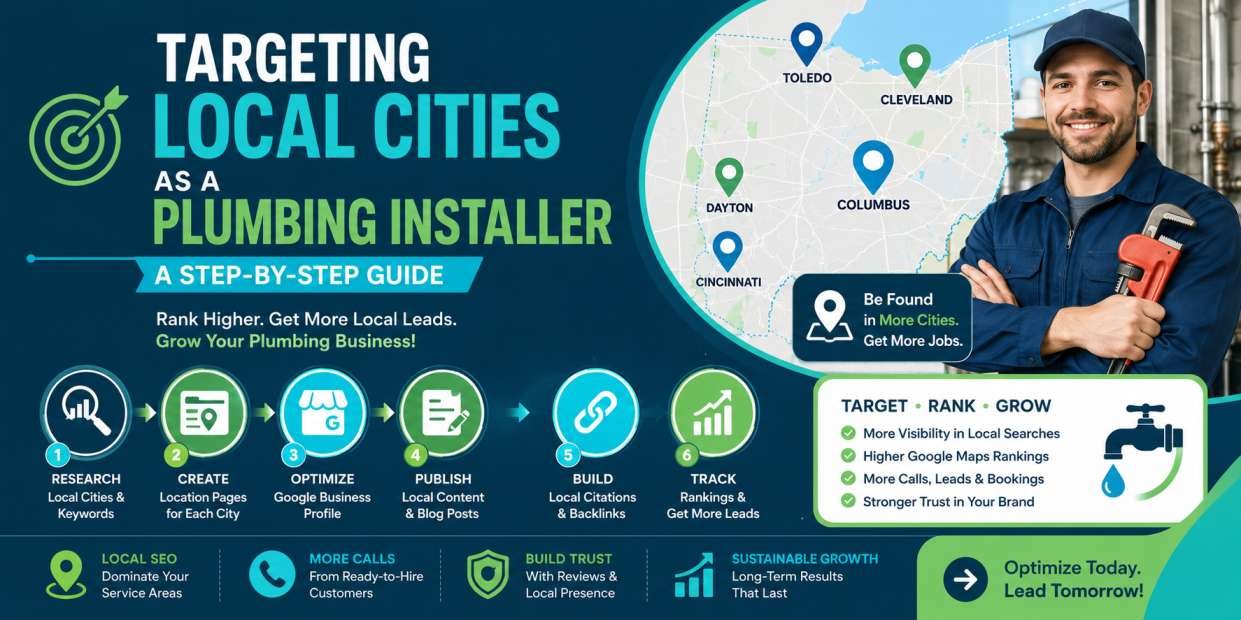
Let’s be real for a second. Most plumbing installers don’t lose business because of bad work. They lose it because nobody could find them.
A homeowner wakes up to a burst pipe on a Tuesday morning. Their first move isn’t to ask a neighbor or flip through a directory. They grab their phone, type “emergency plumber near me,” and call whoever shows up at the top of the results. That decision happens within two minutes. And if your business isn’t visible in that moment, you simply don’t exist to that customer — no matter how good you are at your job.
What makes this even more urgent is the shift happening in how people search. Mobile searches for emergency plumbers have grown steadily year after year. “Near me” searches across home services are now among the highest-intent queries on Google. People aren’t browsing — they’re ready to hire. Right now. In their city, their neighborhood, their street.
For plumbing installers, this creates both a challenge and a massive opportunity. The challenge is that the local search landscape is competitive. Every town, every suburb, every mid-sized city has a handful of plumbing companies fighting for the same screen real estate. The opportunity is that most of them are doing it wrong — or not doing it at all.
That’s where local SEO for plumbers becomes the game-changer. Instead of running ads that drain your budget the moment you stop paying, local SEO builds a lasting digital presence in every city you want to serve. And when done strategically — targeting multiple cities, creating the right content, and showing up on Google Maps — it can transform a single-location plumbing business into a multi-city lead generation machine.
This guide walks you through exactly how to do it, step by step.
Why City-Based SEO Matters for Plumbing Installers
Before we get into the tactics, it helps to understand why targeting individual cities — rather than going broad — is the right approach for plumbing businesses.
Think about how customers actually search. Nobody types “best plumber in the country.” They type “water heater installer in Columbus” or “pipe repair services in Cleveland” or “emergency plumber near me.” Those searches are hyper-local by nature. Google knows it. And Google’s algorithm is built to match those searches with the most relevant, nearby businesses.
This matters for a couple of reasons.
First, customers strongly prefer local service providers. When someone’s basement is flooding, they want someone who can show up fast — not a company headquartered two states away. Proximity is a trust signal before the first call is even made.
Second, Google’s local ranking algorithm weighs three things above almost everything else: relevance, proximity, and prominence. Relevance means your business matches what the customer searched for. Proximity means you’re geographically close. Prominence means your online presence — reviews, citations, website authority — backs you up. City-based SEO is how you control all three of those factors across multiple service areas simultaneously.
Third, and this is the part most plumbing installers miss: if you only optimize for one city, you’re leaving enormous lead potential untapped. A plumber based in Columbus who also serves Dayton, Toledo, Cincinnati, and Cleveland is theoretically eligible for five times the search traffic — but only if their online presence actually reflects those service areas.
Understanding what is local SEO for plumbers and how it differs from generic website SEO is the first mental shift that changes everything. Generic SEO is about ranking for broad terms. Local SEO is about showing up for the specific searches that real customers in real neighborhoods are typing right now.
The difference between the two determines whether your phone rings or not.
Step 1 — Identify Your Target Cities and Service Areas
Before you build a single webpage or write a single blog post, you need to get strategic about which cities are actually worth targeting.
This sounds obvious, but most plumbing businesses skip this step entirely. They either target one city (their home base) and miss out on surrounding markets, or they try to target everywhere and end up ranking nowhere. The answer is a focused, deliberate list of cities based on real data — not guesswork.
Factors to evaluate when choosing target cities
- Search volume — How many people in that city are searching for plumbing services each month? Free tools like Google Keyword Planner can give you a rough picture. A city with strong search demand is a city worth targeting.
- Competition level — Are there already five established plumbing companies dominating Google in that city? Or is the local map pack relatively open? Smaller cities and suburbs often have less competition, which means faster results for less effort.
- Population and homeownership rates — More homeowners mean more potential plumbing customers. Cities with high rates of older housing stock are particularly valuable, since aging pipes and outdated systems generate consistent service calls.
- Income demographics — Higher-income areas often produce higher-value jobs. If you offer premium services like whole-home repiping, tankless water heater installations, or sewer line replacements, targeting areas where homeowners can afford those services matters.
- Distance and service radius — Be realistic about how far your team can travel while still delivering fast, quality service. A plumbing installer based in Columbus probably can’t profitably serve someone four hours away. But covering Columbus, Dublin, Westerville, and Gahanna? Absolutely manageable.
A practical example
Say you’re a plumbing installer based in central Ohio. A realistic and profitable multi-city target list might look like this:
- Columbus — primary market, highest search volume, competitive but high reward
- Cleveland — second major metro, different customer base, worth a dedicated push
- Cincinnati — strong southwestern Ohio market, distinct geographic audience
- Toledo — often overlooked by competitors, solid demand with less noise
- Dayton — growing market with consistent plumbing demand
These aren’t random picks. They’re Ohio’s major population centers — each with its own search audience, its own competitive dynamics, and its own opportunity for a plumbing installer willing to show up properly online.
Step 2 — Perform Local Keyword Research
Once you know which cities to target, the next step is finding the exact words and phrases customers in those cities are using to search for your services.
This is where a lot of plumbing businesses either overcomplicate things or don’t go deep enough. Good local keyword research is actually pretty straightforward — it just requires thinking like your customer, not like a marketer.
A. City + service keywords
These are the most direct, highest-intent keywords you can target. They combine what you do with where you do it.
- “Plumbing installer in Columbus”
- “Water heater installation Cleveland”
- “Emergency plumbing Dayton”
- “Drain cleaning services Cincinnati”
- “Pipe leak repair Toledo”
Every city on your target list should have a corresponding set of service keywords. These become the foundation of your location pages and your Google Business Profile optimization.
B. Long-tail keywords
Long-tail keywords are longer, more specific phrases. They usually have lower search volume, but the people searching them are further along in the buying process — which means they convert better.
- “Affordable drain cleaning in Toledo”
- “24/7 emergency plumber in Cincinnati”
- “Best water heater replacement company in Columbus”
- “Who fixes burst pipes in Dayton?”
- “How much does pipe repair cost in Cleveland?”
These phrases are gold for blog content and FAQ pages. They’re also easier to rank for because fewer competitors are targeting them specifically.
C. “Near me” keywords
“Near me” searches deserve their own category because they behave differently from other local searches. When someone types “plumber near me,” they’re not specifying a city — they’re letting Google use their location to find the most relevant result.
You don’t literally optimize for the phrase “near me.” Instead, you optimize your Google Business Profile, build local citations, and create location-specific pages so that Google’s algorithm correctly identifies your service area and serves your business to nearby searchers.
If you’re expanding across Ohio, a broader statewide resource on SEO for plumbers in Ohio can give you a strong foundation before drilling down into city-specific campaigns.
Step 3 — Create Dedicated Location Pages
This is the single most impactful thing a plumbing installer can do to rank in multiple cities — and it’s the step that most businesses either skip or execute poorly.
Here’s the core principle: Google wants to serve its users the most relevant result for their search. If someone in Cleveland searches for a plumbing installer, Google is going to favor a business that has a page specifically about plumbing installation in Cleveland — not a business that mentions Cleveland once in a generic “we serve all of Ohio” paragraph.
Each city you want to rank in needs its own dedicated, fully optimized page.
What to include on each location page
- Unique city-specific content — This is the critical one. You cannot simply copy-paste the same content across multiple city pages and swap out the city name. Google calls this duplicate content, and it either ignores those pages or penalizes them outright. Each page needs genuinely unique writing that speaks to that specific city’s context, needs, and character.
- Services offered — Be specific. Don’t just say “we offer plumbing services.” List out what you do: water heater installation, drain cleaning, leak detection, pipe replacement, sewer line repair. Give each service a brief description that’s written for a Cleveland customer, not a generic one.
- Local landmarks and context — Mention the neighborhoods you serve within that city. Reference local context that signals you actually know and serve that area. This builds trust with readers and sends geographic relevance signals to Google.
- Customer testimonials — Real reviews from real customers in that city are powerful. A Cleveland homeowner reading a testimonial from another Cleveland homeowner feels an immediate sense of trust and relatability.
- FAQs specific to that location — Common questions vary by geography. Toledo’s older housing stock might generate different plumbing questions than a newer Cincinnati suburb. Tailor your FAQs accordingly.
- Google Maps embed — Embed a Google Map of your service area on each location page. It’s a small detail that reinforces geographic relevance and helps customers understand your service radius.
Here’s how the city page strategy maps out for an Ohio-based plumbing installer:
-
- For plumbing SEO in Columbus, your page should reflect Columbus’s diverse neighborhoods — from Clintonville to German Village to Dublin — and speak to the plumbing needs of that specific market.
- Your approach to Cleveland plumbing SEO should acknowledge Cleveland’s aging housing stock, its distinct East and West Side neighborhoods, and the unique plumbing challenges that come with older homes.
- When building out local SEO for plumbers in Dayton, focus on Dayton’s suburban communities and the types of plumbing jobs that are common in mid-sized Midwestern cities.
- A strong page targeting SEO for plumbers in Toledo should highlight your ability to serve both the city core and the surrounding suburban areas in Lucas County.
- And for Cincinnati plumbing SEO, lean into the city’s hillside neighborhoods, its mix of historic and modern homes, and the plumbing demands that come with Cincinnati’s geography.
Each of those pages is a separate asset working for you around the clock — pulling in search traffic from a specific city even while you’re out on a job.
Step 4 — Optimize Your Google Business Profile
If location pages are the foundation of city-based SEO, your Google Business Profile is the front door. It’s what gets you into the local map pack — those top three business listings that appear with a map above the regular search results — and it’s what most customers see before they ever click through to your website.
Getting your profile fully optimized isn’t complicated, but it requires attention to detail that most plumbing businesses completely ignore.
Service area setup
Don’t just list your home city. Add every city you want to rank in as a service area. Be specific — list individual cities and towns rather than just counties. Google uses this information to determine which searches your business is eligible to appear for.
Business categories
Your primary category should be “Plumber.” But don’t stop there. Add secondary categories that reflect your specific services — “Drainage Service,” “Water Heater Installer,” “Sewage Disposal Service.” The more accurately your categories reflect what you actually do, the better Google can match you to relevant searches.
Photos
Businesses with photos on their Google profile get significantly more clicks and direction requests than those without. Add real photos — your team at work, your vehicles, completed jobs, your equipment. Skip the stock photos. Customers can tell the difference, and authenticity builds trust.
Reviews — and how to actually get them
Reviews are arguably the most powerful ranking factor in local SEO, and they also do the conversion work once a customer finds you. A plumbing company with 80 reviews and a 4.8-star average will get more calls than one with 12 reviews and a 4.3, even if the work quality is identical.
The most effective way to get reviews is simple: ask. After every completed job, send the customer a direct link to your Google review page. Most satisfied customers are happy to leave a review — they just need the prompt and the convenience of a direct link.
Respond to every review, positive and negative. Thanking customers publicly for positive reviews shows engagement. Responding professionally to critical reviews shows character — and potential customers are watching both.
Weekly posts and updates
Google Business Profile lets you post updates, promotions, and service highlights. These posts appear on your profile and signal to Google that your business is active. Post consistently — new content, seasonal tips, service reminders. It takes ten minutes a week and adds up over time.
Step 5 — Publish Localized Blog Content
Once your location pages are live and your Google profile is optimized, the next layer of a strong local SEO strategy is content. Specifically, blog content that’s tied to the cities you serve and the plumbing questions your customers are actually asking.
This matters for a few reasons. Google rewards websites that demonstrate consistent topical expertise. A plumbing installer who publishes ten thoughtful blog posts about plumbing problems in their service area looks like an authority. An installer with a five-page website and nothing else looks like just another name in the directory.
Good localized blog content also captures long-tail search traffic — all those specific questions people type when they’re not quite ready to call but are definitely researching their options.
Here are blog topics that work well for Ohio-based plumbing installers:
- “Common Plumbing Problems in Ohio Winters and How to Prevent Them”
- “Signs You Need Pipe Repair Before Winter Hits in Columbus”
- “Best Water Heater Options for Cleveland Homes: A Homeowner’s Guide”
- “How to Prevent Frozen Pipes in Dayton When Temperatures Drop”
- “What Toledo Homeowners Need to Know About Old Cast Iron Pipes”
- “Why Cincinnati’s Hillside Homes Have Unique Drainage Challenges”
Notice how each of these is useful, specific, and tied to a real location. A Columbus homeowner searching for “pipe repair signs Columbus” has a good chance of landing on your article — and if that article is well-written and genuinely helpful, they’ll remember your business name when they need a plumber.
For a broader understanding of how content fits into your overall digital strategy, read more about how SEO for plumbing services boosts online visibility and trust — it covers the full picture of why content-driven SEO outperforms most other marketing approaches for plumbing businesses.
Step 6 — Build Local Citations and Backlinks
Think of citations and backlinks as votes of confidence from the internet. Every time your business is listed accurately on a reputable directory, Google sees that as a signal that your business is legitimate. Every time another website links back to yours, Google sees it as an endorsement.
For plumbing installers, citations are relatively straightforward to build. Start with the most impactful directories:
- Yelp — Still heavily used for home services, especially in major metros
- Angi (formerly Angie’s List) — One of the most visited home services platforms in the US
- HomeAdvisor — High traffic, strong authority signal
- Better Business Bureau (BBB) — Trust signal that customers actively look for
- Local Chamber of Commerce — City-specific authority that Google values for local rankings
The single most important rule with citations is consistency. Your business name, address, and phone number (NAP) must be identical across every listing. Not similar — identical. “Dave’s Plumbing LLC” and “Dave’s Plumbing” are technically different in Google’s eyes. Inconsistencies confuse search engines and can quietly drag your rankings down.
For backlinks, plumbing installers have more opportunities than most people realize:
- Guest posting — Write a helpful article for a local home improvement blog or neighborhood website. You provide useful content; they give you a link back to your site.
- Supplier partnerships — If you work with local supply companies, wholesalers, or manufacturers, ask if they list their certified installers or contractors on their website. A link from a supplier’s site carries real authority.
- Local sponsorships — Sponsoring a Little League team, a neighborhood event, or a local charity often comes with a mention and link on the organization’s website. Small links like these add up.
- Local press — If you do something newsworthy — a community service, a record job, a charity effort — a mention in a local news outlet’s online edition is an extremely valuable backlink.
Step 7 — Optimize for Mobile and User Experience
Here’s a number that should make every plumbing installer rethink their website: more than 60% of local service searches happen on mobile devices. And that percentage is even higher for emergency searches — the person whose pipe just burst at midnight is absolutely using their phone.
Google responded to this reality by switching to mobile-first indexing, which means it evaluates the mobile version of your website when deciding where to rank you. A website that looks great on a desktop but breaks on a phone is not just inconvenient — it actively hurts your search rankings.
For a plumbing installation business, mobile optimization isn’t optional. It’s the baseline.
- Fast loading speed — If your page takes more than three seconds to load on a mobile connection, a significant portion of visitors will leave before they see a single word. Compress your images, minimize unnecessary code, and test your loading speed regularly with Google’s PageSpeed Insights.
- Click-to-call buttons — This one is so simple and so often missed. Your phone number should appear prominently at the top of every page, and it should be a tappable link that dials automatically. A potential customer on their phone who has to manually copy and paste a number is a potential customer who’s going to call your competitor instead.
- Easy navigation — Mobile menus should be clean, thumb-friendly, and logical. A visitor should be able to get from your homepage to your “Emergency Plumbing” service page in two taps or less.
- Online booking forms — Offering an online booking or inquiry form gives customers who aren’t ready to call an easy alternative. Keep it short — name, phone, service needed, preferred time. Long forms get abandoned.
Step 8 — Track Your Rankings and Local SEO Performance
You can’t improve what you don’t measure. A lot of plumbing installers invest in SEO for a few months, don’t see instant results, and conclude that it isn’t working — when in reality, significant progress was happening that they simply couldn’t see because they weren’t tracking the right things.
Here are the metrics that actually matter for local plumbing SEO:
- Local keyword rankings — Are you moving up in the search results for your target city + service keyword combinations? Use a rank tracking tool to monitor your position for keywords like “plumbing installer in Columbus” or “water heater repair Cleveland” over time.
- Website traffic by city — Google Analytics shows you where your website visitors are coming from geographically. As your local SEO improves in specific cities, you should see traffic from those cities increasing.
- Google Business Profile insights — Your GBP dashboard shows you how many people viewed your profile, how many clicked for directions, and how many called directly from the profile. These numbers should trend upward as your profile authority grows.
- Phone calls and form submissions — Ultimately, the most important number is how many qualified leads you’re generating. Track whether inbound calls and contact form submissions are increasing month over month.
- Conversion rate — Of the people who visit your website or call your number, what percentage book a job? This isn’t purely an SEO metric, but it tells you whether your website is doing its job of converting curious visitors into paying customers.
Tools you’ll use for this:
-
- Google Analytics for website traffic and behavior
- Google Search Console for keyword visibility and technical site health
- Google Business Profile Insights for map pack and profile performance
Review these numbers monthly. Look for trends, not single-day snapshots. SEO results compound over time — a page that barely ranks in month two might be on page one by month five.
7 Common Mistakes Plumbing Installers Should Avoid
Even plumbing businesses with good intentions make mistakes that silently sabotage their local SEO. Here are the ones that show up most often:
- Duplicate city pages — Copying one location page and swapping the city name is one of the most common and damaging mistakes in local SEO. Google detects duplicate content quickly and either ignores those pages or filters them out of rankings entirely. Every city page needs genuinely unique content.
- Keyword stuffing — Cramming “plumbing installer in Columbus” into every other sentence doesn’t fool Google and definitely annoys human readers. Write naturally. Use the keyword where it fits, not everywhere it can be forced.
- Ignoring reviews — Not asking satisfied customers for reviews, not responding to the ones you receive, and not addressing negative feedback are all missed opportunities. Reviews are both a ranking signal and a conversion tool. Neglecting them costs you on both fronts.
- Inconsistent NAP information — If your business is listed with three different phone numbers and two different addresses across various directories, Google struggles to trust your information. Audit your citations regularly and fix inconsistencies immediately.
- Thin content — A location page with two paragraphs and a contact form isn’t going to rank. Google evaluates content depth as a quality signal. Each city page should be thorough, genuinely useful, and specific enough that a local resident would find it valuable.
- No internal linking — Every page on your website is an opportunity to guide visitors deeper into your site and to pass SEO authority between pages. Link your city pages to relevant service pages. Link your blog posts to location pages. Build a web of connections, not a collection of isolated pages.
- Poor mobile experience — A slow, difficult-to-navigate mobile site will cost you rankings and customers. Test your site on your own phone regularly. If something frustrates you, it’s frustrating your potential customers too.
If budget is a concern, there are affordable plumbing SEO strategies that prioritize the highest-impact actions first — so you get real results without overspending in the early stages of your campaign.
8 Benefits of Multi-City Plumbing SEO
When you execute a city-targeted local SEO strategy consistently, the results compound in ways that single-city or generic SEO simply can’t match:
- More local leads from multiple markets — Instead of relying on one city for all your inbound traffic, you have five, ten, or fifteen cities generating leads simultaneously
- Better Google Maps visibility — Proper multi-city optimization gets you into the local map pack in each target city, which is where the majority of clicks go
- Expanded service reach without expanding your advertising budget — Organic rankings cost the same whether you rank in one city or ten
- Increased inbound phone calls — More visibility in more cities means more people calling you directly from search results
- Stronger overall online authority — A website with multiple high-quality location pages, regular blog content, and strong citations carries more weight with Google than a basic brochure site
- More organic traffic month over month — Unlike paid ads that stop working the moment you pause them, organic rankings keep delivering traffic indefinitely
- Reduced dependency on paid advertising — As your organic presence grows, you can reduce or eliminate Google Ads spend without sacrificing lead flow
- Long-term business growth — The businesses that invest in local SEO today are building an asset that will generate leads for years — not just until the next campaign ends
The Future of Local SEO for Plumbing Installers
Local search is not standing still, and the plumbing businesses that understand where it’s heading will have a significant advantage over those that don’t.
AI-powered search — Google’s AI-driven search features are changing how results are displayed. Businesses with deep topical authority, consistent information across the web, and high-quality content are better positioned as AI shapes search results. The fundamentals of good local SEO — accuracy, relevance, helpfulness — matter even more in this landscape, not less.
- Voice search optimization — More homeowners are using voice assistants to find local services. “Hey Google, find a plumber near me” is now a real and common search behavior. Voice queries tend to be longer and more conversational, which is another reason why FAQ pages and naturally written content perform well.
- Hyperlocal SEO — As competition increases at the city level, the next frontier is neighborhood-level targeting. A plumbing installer who creates content specifically for Clintonville in Columbus, or Tremont in Cleveland, will have a meaningful advantage over competitors targeting only at the city level.
- Reputation management — Reviews and online reputation are only growing in importance. Google factors in review recency, response rate, and volume when ranking local businesses. A proactive review strategy isn’t optional anymore — it’s a core part of competitive local SEO.
- Personalized search results — Google increasingly tailors results to the individual searching — based on their location, search history, and behavior. This makes authentic, locally relevant content even more valuable, because generic content gets filtered out in favor of results that match the user’s specific context.
Conclusion
Here’s the honest truth about targeting local cities as a plumbing installer: the opportunity is real, the barrier is lower than most people think, and the businesses that act now will be the ones that own their local markets for years.
Every day that passes without a dedicated location page for Cleveland, or a properly optimized Google Business Profile, or a blog post about common plumbing issues in Cincinnati — is a day that a competitor is quietly building exactly that and collecting the leads you could have had.
Multi-city local SEO isn’t about trying to trick Google. It’s about genuinely showing up for the customers who need you, in the places where they’re looking, with the information and credibility that makes them confident enough to call. Location pages, localized content, consistent citations, strong reviews, and a mobile-friendly website — these aren’t complicated things. But they require consistency, intention, and time.
The plumbing installers who commit to this process see their phones ring more. They get leads from cities they’ve never run a single ad in. They watch their Google Maps ranking improve month after month. And eventually, they stop worrying about where the next job is coming from — because the pipeline is full.
If you’re ready to start building that kind of presence, the first step is simply picking up the strategy and running with it, one city at a time.
Frequently Asked Questions
How do plumbers rank in multiple cities? Ranking in multiple cities requires creating dedicated location pages for each city, optimizing your Google Business Profile to include those cities as service areas, and building local content and citations relevant to each location. There’s no shortcut — each city needs its own genuine, optimized presence. Businesses that invest in this systematically can rank in five, ten, or more cities simultaneously over time.
Do I need separate pages for every city I serve? Yes — and not just separate pages, but genuinely unique ones. A page that’s been copied and has only the city name swapped out will either rank poorly or not at all. Google’s algorithms detect duplicate content quickly. Each city page needs unique writing, specific local references, and content that’s actually useful to someone in that city.
How important is Google Business Profile for plumbers? It’s arguably the single most important piece of local SEO infrastructure for a plumbing business. The local map pack — the three business listings that appear at the top of most local searches — is driven primarily by Google Business Profile signals. A fully optimized profile with consistent information, regular updates, and active review management dramatically improves your chances of appearing there.
Can local SEO generate emergency plumbing leads? Absolutely, and these are often the highest-value leads a plumbing business can capture. Emergency searches like “burst pipe repair near me” or “24-hour plumber in Columbus” have extremely high intent — the person is ready to hire immediately. Ranking for these keywords puts your business in front of customers at the exact moment they need help most.
How long does local SEO take for plumbing businesses? Most businesses start seeing measurable movement in three to six months of consistent effort. Meaningful results — steady leads, page-one rankings, consistent map pack appearances — typically develop over six to twelve months. The timeline depends on your starting point, the competitiveness of your target cities, and how consistently the strategy is executed. SEO is a long-term investment, but one that compounds and pays dividends indefinitely.
What are the best keywords for plumbing installers? The most valuable keywords combine your specific services with your target cities: “plumbing installer in Columbus,” “water heater replacement Cleveland,” “emergency plumber Cincinnati.” Beyond those, long-tail keywords that reflect specific customer questions — “how to know if I need pipe replacement,” “signs of a sewer line problem” — attract high-intent visitors who are actively researching before they call. A strong keyword strategy uses both types together.